

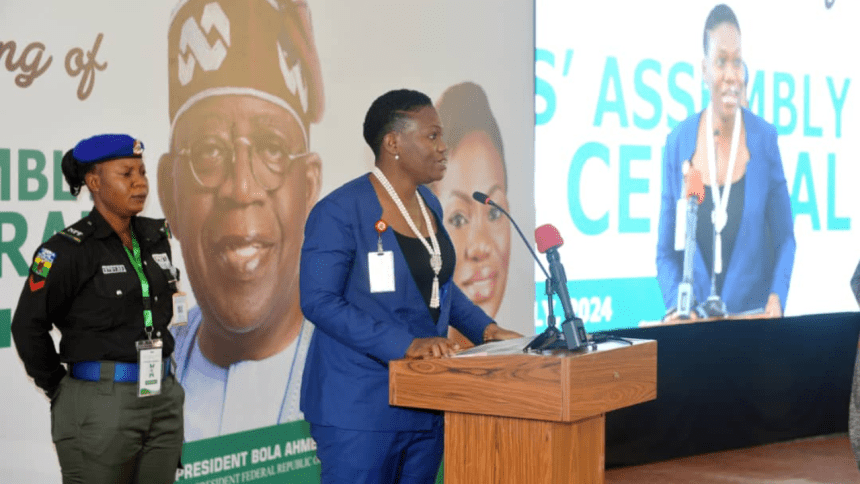
Nearly 70 per cent of security challenges in the North-Central part of the country can be resolved through non-kinetic means anchored on communities, Senior Special Assistant to the President on Community Engagement (North-Central), Dr Abiodun Essiet, has said.

Essiet said this Tuesday while speaking at the capacity-building training for stakeholders in the North-Central held at the State House in Abuja.
“From our analysis, nearly 70 percent of the security challenges in the North Central can be addressed through dialogue, reconciliation, intelligence sharing, and community engagement, rather than through force alone,” she said.
She stressed the for early resolution of conflicts, stressing that tackling local disputes early is decisive.
“Once we succeed in resolving internal communal conflicts and addressing the root causes of tension, we will already be halfway to overcoming insecurity in the North Central while armed criminality remains for security agencies,” she said.
Recalling the June 5 launch of the Presidential Community Engagement Peace Initiative (PCEPI) in Jos, Plateau state, Essiet said: “That historic event was a significant step in our collective journey toward fostering unity, strengthening social cohesion, and empowering communities to take ownership of their peace processes.”
She said in line with Nigeria’s implementation of United Nations Universal Periodic Review (UPR) recommendations, her office is partnering the International Communities Organisation (ICO) on a project titled “Promoting Community Peace and Strengthening Social Cohesion in North Central Nigeria.”
She said the project is a grassroots network that leaves no LGA behind, stressing that “at the heart of this initiative is the establishment of a peace structure that will cut across all the 110 local governments in the North-Central region.”
“This structure will not just exist in name; it will be an active platform … focusing on gathering and sharing intelligence, facilitating continuous dialogue, and helping us identify underlying issues and root causes of conflict. Ultimately, this peace structure will serve as the backbone of sustainable peacebuilding in our region,” she said.
Stakeholders highlighted forests and borders as pressure points. The Commandant-General of the Nigerian Forest Security Service (NFSS), Ambassador Joshua Osatimehin Wole, said Nigeria has 1,129 forest reserves, with 174 in the North-Central.
He called for tighter inter-agency cooperation and effective forest control, identifying Niger, Kwara and Benue as epicentres requiring enhanced surveillance.
“For sustainable peace in our communities, all our forested regions must be well coordinated and preserved. We need to protect the forests.
“We must create additional security agencies to conduct continuous security surveillance. Three states border international frontiers—Niger, Kwara and Benue—and they are the epicentres of insecurity.There should be inter-agency cooperation and effective control of our forests.
“What Nigeria is currently going through goes beyond farmers–herders clashes. We must also consider the post-Gaddafi era,” he said.
The Director of the MacArthur Foundation, Kole Shettima, underlined the centrality of stability to development.
“Unless there is peace, you cannot do what you want to do. Peace is essential and paramount,” he said.
He urged the National Assembly to strengthen traditional institutions, stressing that “we have to look historically at how our elders solved conflicts and learn from it.”
Project coordinator Jacob Alagbe said the programme brings state-level actors together to promote peaceful coexistence and social cohesion, with outputs feeding into state-specific action plans.