
Business

CBN, FRACE deepen governance framework for non-interest financial institutions
The Central Bank of Nigeria (CBN) has reaffirmed its commitment to strengthening Shariah governance, regulatory clarity, and risk management in...
Read moreCBN concludes banking sector recapitalisation programme, N4.65 trillion raised to strengthen financial System Resilience
The Central Bank of Nigeria (CBN) has announced the successful conclusion of the banking sector recapitalisation programme initiated in March 2024. Over the 24month period, Nigerian banks raised a total of ₦4.65 trillion in new capital, strengthening the resilience of the financial system and enhancing its capacity to support the economy. The programme recorded strong participation from both domestic and international investors, with 72.55% of capital sourced locally and 27.45% from international markets, reflecting sustained confidence in the Nigerian banking sector. Governor Olayemi Cardoso commented: “The recapitalisation programme has strengthened the capital base of Nigerian banks, reinforcing the resilience of the financial system and ensuring it is wellpositioned to support economic growth and withstand domestic and external shocks.” The CBN confirmed that 33 banks have met the revised minimum capital requirements established under the programme. A limited number of institutions remain subject to ongoing regulatory and judicial processes, which are being addressed through established supervisory and legal frameworks. All banks remain fully operational, ensuring continued access to banking services for customers. The programme has strengthened capital adequacy ratios (CAR), with the sector maintaining levels above international Basel benchmarks. Minimum CAR thresholds remain at 10% for regional and national banks and 15% for banks with international authorization. The recapitalisation, implemented alongside an orderly exit from regulatory forbearance, has improved asset quality, reinforcing balance sheet transparency and overall financial system stability. To safeguard these gains, the CBN has strengthened its risk-based capital adequacy framework, requiring banks to conduct regular stress testing across defined scenarios and maintain appropriate capital buffers. Key regulatory measures, including prudential guidelines and the supervisory framework, are subject to periodic review to support ongoing strengthening of governance, risk management, and sector resilience. Continuity of Operations and System Stability The recapitalisation programme was carried out without disruption to banking services, ensuring continuous access for individuals and businesses throughout the process. The successful completion of the programme establishes a stronger and more resilient banking system, better positioned to support lending, mobilise savings, and withstand domestic and global shocks. The Central Bank of Nigeria remains committed to maintaining a stable, transparent, and resilient financial system that inspires confidence among depositors, investors, and the broader public, and to advancing the sustainability of the nation’s financial architecture.
Read more
African ministers outline industry priorities ahead of Mining Week 2026
With the demand for critical minerals projected to quadruple by 2040 and traditional commodities such as gold reaching record highs...
Read more
Banking sector recapitalisation on course – Cardoso
The Governor of the Central Bank of Nigeria (CBN), Mr Olayemi Cardoso, stated that the banking sector recapitalisation programme is...
Read more
Cardoso tasks Central Banks, DFIs on Africa’s Growth CAIRO
The Governor of the Central Bank of Nigeria (CBN) Mr Olayemi Cardoso has stated that Africa must grow, industrialise, create...
Read moreCardoso hails AU decision on African Monetary Institute, Central Bank
The Governor of the Central Bank of Nigeria (CBN), Mr. Olayemi Cardoso, has lauded the recent decision of the 39th...
Read moreCBN okays weekly FX Sale of $150k to BDCs
The Central Bank of Nigeria (CBN) has approved the participation of licensed Bureau De Change (BDC) operators in the Nigerian...
Read moreCBN releases fintech report, maps path for Nigeria’s digital finance future
The Central Bank of Nigeria (CBN) has published a detailed report on the country’s fintech ecosystem, setting out key priorities...
Read more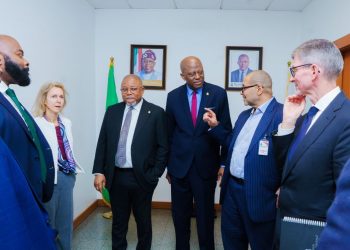
Cardoso hosts British international investment
…Reaffirms commitment to financial sector reform, long-term capital The Governor of the Central Bank of Nigeria (CBN), Mr. Olayemi Cardoso,...
Read more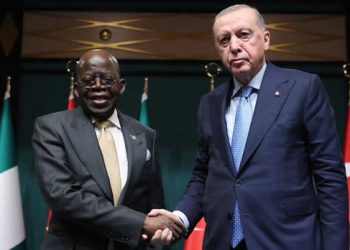
We’re targeting $5 billion trade volume with Nigeria – President Erdogan
President Recep Tayyip Erdogan of the Republic of Turkiye on Tuesday in Ankara, reaffirmed his country’s commitment to a $5...
Read more