
Governor Peter Mbah of Enugu State has called for education to be treated as a national emergency, saying Nigeria must back its development ambitions with substantial investment in schools, teachers, and young people.
Mbah made the call at the 2026 Enugu Education Summit and the unveiling of the state’s education policy at the International Conference Centre in Enugu.
The summit examined leadership, innovation, partnerships, financing and sustainable education reform.
The governor said an emergency response must be evident in budget allocations, teacher training, learning infrastructure and educational standards, supported by stronger collaboration among governments, development agencies and the private sector.
He said Nigeria could neither overcome poverty nor achieve lasting prosperity without addressing deficiencies in knowledge, skills and productive capacity.
He said the country must prepare its young people to develop ideas, technologies, and products that meet global needs.
“So, if Nigeria is to become a creation economy rather than a consumption economy, then we must equip our young people not simply to use what the world creates, but to research, design, engineer, and create what the world needs,” he said.
Mbah stressed that meaningful reform required sustained financing.
“The point here is straightforward: transformation cannot survive on aspiration alone. Eventually, somebody has to pay for it,” he said.
He said Enugu had committed 33 per cent of its annual budget to education for three consecutive years, supporting the construction of 268 Smart Green Schools and more than 7,000 classrooms equipped with modern learning facilities.
The governor explained that his administration opted for a comprehensive overhaul after determining that limited improvements to the existing system would not adequately prepare children for the future.
“When we came into government, we could have repaired the existing system. We could have renovated some classrooms, supplied some desks, put computers into a few schools and called it reform,” he said.
“But we had to ask ourselves a more difficult question: would it be enough? Would an education system essentially designed for the world of 40 years ago prepare an Enugu child for the world of 20 years from now? Our answer was ‘No’.”
Unveiling the Enugu State Education Policy, Mbah said implementation had already begun and that the document would guide standards and development in the sector over the next six to 10 years.
The United Nations Children’s Fund, the United Nations Educational, Scientific and Cultural Organisation, the British Council, and other stakeholders commended the administration’s emphasis on education.
UNICEF Country Representative to Nigeria, Wafaa Saeed, represented by the Chief of Field Office in Enugu, Juliet Chilewe, praised the state’s investments in Smart Green Schools, teachers, foundational learning, digital literacy and experiential education.
She said UNICEF was proud to have supported the development of the Enugu State Education Sector Plan 2026–2035.
UNESCO also commended the construction of 268 Smart Green Schools, the establishment of the Centre for Experiential Learning and Innovation, and plans to recruit more than 6,000 teachers.
Its Representative to Nigeria, Dr Isaias Barreto da Rosa, represented by the Officer-in-Charge of the Education Sector, Adeyemi Oladeji, described the Smart Green Schools programme as a landmark achievement.
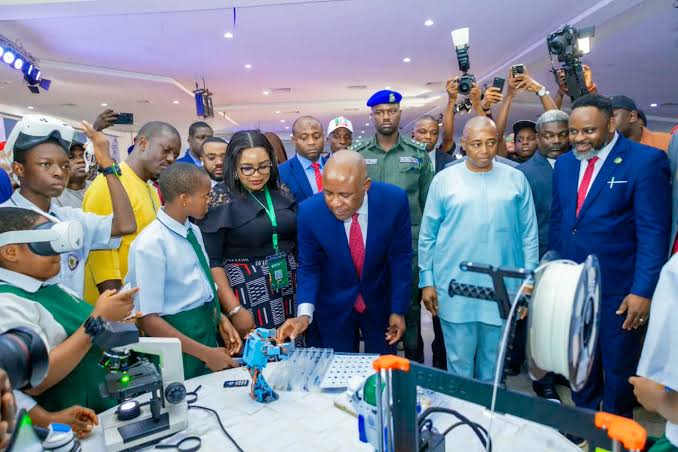
The event featured the formal unveiling of the education policy and a tour of the Smart Green School Innovation Studio, where students displayed their inventions.