
Investigative journalism has been identified as a vital instrument for national re-orientation and democratic growth, as the Director-General of the National Orientation Agency (NOA), Mr Lanre Issa-Onilu, urged media professionals to return to depth, accuracy and fact-based reporting in the national interest.
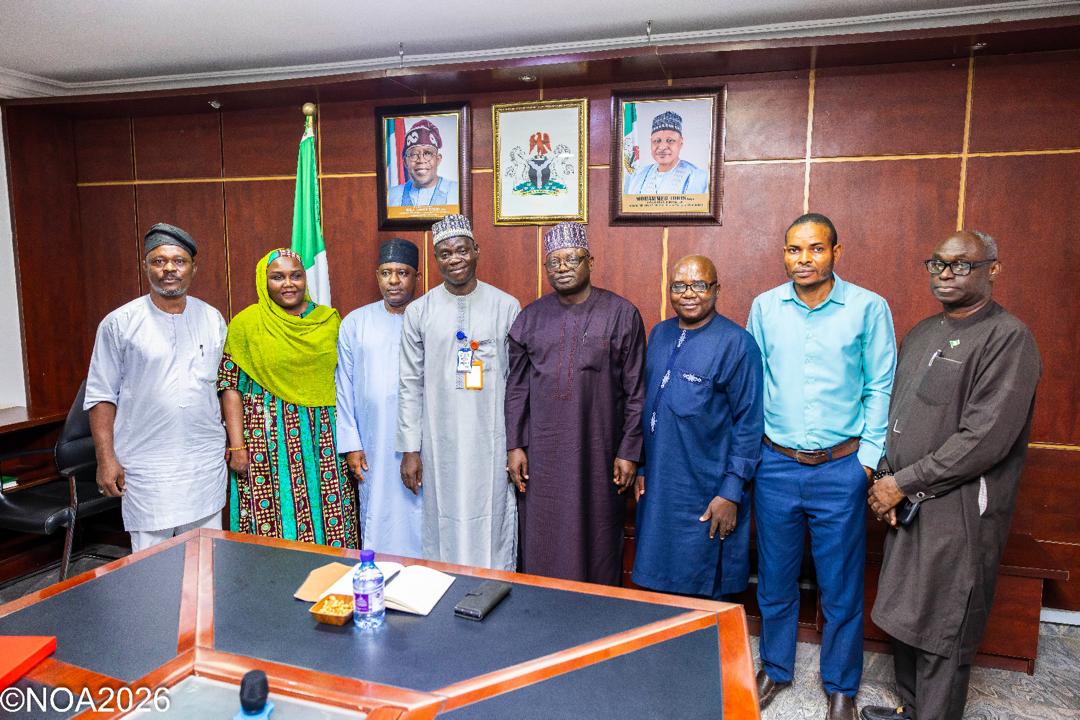
Issa-Onilu spoke in Abuja when he received a delegation from the Nigerian Guild of Investigative Journalists (NGIJ), led by its National President, Malam Abdulrahman Aliagan, during a courtesy visit aimed at strengthening collaboration between the two institutions.
The NOA Director-General affirmed that investigative journalism plays a decisive role in national development by promoting fairness, balance and objectivity, while also compelling government to act responsibly under informed public scrutiny.
Issa-Onilu lamented what he described as a steady decline in investigative journalism across the country, stresing that the erosion of depth, accuracy and commitment to verifiable facts has weakened journalism and contributed to the spread of misinformation and social division.
According to him, journalism practice has increasingly become superficial, with insufficient attention paid to interpretation, context and evidence-based reporting.
This development, he said, has blurred the line between professional journalism and unverified content circulating on social media platforms.
He stressed that facts remain fundamental to civic orientation and national unity.
When facts are no longer treated as sacred, he warned, society becomes vulnerable to ignorance, manipulation and conflict.
He said that weak investigative reporting has contributed to knowledge gaps among citizens, especially on governance and electoral processes. Such gaps, he said, often create fertile ground for misinformation and unhealthy public discourse.
He outlined the challenges facing NOA in delivering its mandate, including limited resources for voter education and civic enlightenment.
He pointed to widespread public misunderstanding of electoral procedures as evidence of the consequences of insufficient civic education and poor-quality reporting.
To bridge these gaps, Issa-Onilu pledged the agency’s support for NGIJ and offered to facilitate collaboration through NOA’s nationwide network of Community Orientation and Mobilisation Officers (COMOs). The officers, deployed across local government areas, provide grassroots feedback to government and could serve as credible community-level sources for investigative journalists.
He also proposed the establishment of a joint committee between NOA and NGIJ to identify concrete areas of cooperation, stressing that the proposed collaboration would focus on public enlightenment campaigns, counter-disinformation initiatives and mechanisms to strengthen investigative journalism in the public interest.
The NGIJ delegation used the meeting to canvass a structured partnership with NOA to advance civic education, counter misinformation and reinforce accountability in governance. The Guild maintained that investigative reporting and civic orientation share a common purpose: equipping citizens with credible information and strengthening democratic culture.
Addressing the NOA management team, Aliagan said the mandates of both organisations naturally align.
He explained that while NOA is responsible for public enlightenment, value re-orientation and civic education, investigative journalism supplies verified facts and documented evidence that empower citizens to make informed choices and hold public institutions accountable.
He described investigative journalism as pro-accountability and pro-transparency, clarifying that it is not designed to undermine government but to reinforce institutions and rebuild public confidence.
According to him, responsible presentation of facts, when tied to civic values, produces a more informed, responsible and participatory citizenry.
Aliagan warned that misinformation, waning trust in institutions, social tension and civic apathy pose significant threats to Nigeria’s democracy.
He advocated closer cooperation between journalists and NOA through joint public enlightenment campaigns, training on fact-checking and countering disinformation, as well as platforms that encourage constructive engagement with citizens.
He also called for an enabling environment that supports ethical journalism, guarantees access to information and strengthens institutional backing for investigative reporting. Investigative findings, he said, should be treated as tools for civic learning and national improvement rather than adversarial attacks on government.
Aliagan expressed optimism that the visit would lay the groundwork for a structured and enduring partnership between NGIJ and NOA in the broader task of nation-building.
Members of the NGIJ delegation at the meeting included Comrade James Ezema, Vice President (Investigation); Malam Abdullahi M. Gulloma, National Public Relations Officer; Abdulrahman Obaje, FCT Chapter Chairman; Mr. Leonard Oru; Mr. Kunle Awoniyi; and Falmata Zanna.