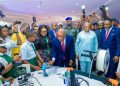


President Bola Ahmed Tinubu on Wednesday declared that the era of manual inefficiency in Nigeria’s public service must give way to a culture of speed, transparency and technology-driven governance, as he directed all Ministries, Departments and Agencies (MDAs) to deepen digitalised work processes across the federal bureaucracy.
Speaking at the opening ceremony of the 2026 International Civil Service Conference in Abuja, the President said the federal government’s reform agenda had begun yielding measurable results, with 38 Ministries and Extra-Ministerial Departments already operating on secure, paperless and end-to-end electronic workflow systems.
Addressing participants drawn from across Africa and other parts of the world, Tinubu said the transformation of the civil service remained central to the success of his administration’s Renewed Hope Agenda, stressing that no government policy could succeed without a disciplined, capable and efficient public service.
“The era of manual inefficiency must give way to a culture of speed, transparency, data-driven decision-making and citizen-centred service. Civil Service Becoming Faster, Smarter,” the President said.
Tinubu said the theme of the conference, “Reforms, Resilience and Results,” reflected Nigeria’s transition from policy aspirations to practical implementation and measurable impact.
According to him, the Nigerian Public Service has, within the past eleven months, demonstrated resilience and adaptability amid global economic pressures and growing domestic expectations.
“You are the engine room of national transformation. Today, that engine is becoming faster, smarter, more accountable and more responsive to the needs of our people,” the President told civil servants and development partners at the conference.
The President said that when his administration first pushed for digitalisation in 2025, many considered it an ambitious long-term vision, but said the country was now witnessing concrete progress in the modernisation of governance systems.
He explained that the digital reforms were designed not only to improve internal government operations but also to promote efficiency, investment, innovation and inclusive economic growth.
Tinubu also linked the ongoing civil service reforms to broader national economic ambitions, particularly the government’s digital infrastructure drive under Project BRIDGE — Building Resilient Digital Infrastructure for Growth.
Recalling discussions at the recent Africa CEO Forum in Rwanda, the President said Nigeria was positioning itself as a major destination for digital infrastructure investment capable of creating jobs, expanding connectivity and improving public service delivery.
“As we accelerate our digital transformation journey, we welcome investors and partners to participate in Nigeria’s digital infrastructure ecosystem,” he said.
He added that agencies of government must adopt digitalisation not only in administrative processes but also in service delivery systems in order to meet modern governance expectations.
The President disclosed that the Personnel Audit and Skills Gap Analysis authorised during the 2025 conference was nearing completion, saying the initiative would help government identify competence gaps and deploy workers more effectively.
According to him, the exercise marks a departure from assumptions about institutional capacity to evidence-based workforce planning.
“We are identifying gaps, strengthening competencies and ensuring that the right people are placed in the right roles,” he said.
Tinubu stressed that the reforms were aimed at equipping public servants with the digital skills and professional discipline required for effective 21st-century governance.
The President specially commended the Head of the Civil Service of the Federation, Mrs. Didi Esther Walson-Jack, for what he described as exemplary leadership in implementing the Federal Civil Service Strategy and Implementation Plan 2021–2025.
He particularly praised the deployment of innovative tools, including the Service-Wise GPT platform, saying it demonstrated the possibilities that emerge when visionary leadership is combined with disciplined execution and institutional ownership.
Tinubu also applauded Ministries, Extra-Ministerial Departments and Agencies for sustaining collaboration and reform momentum, noting that Nigeria was gradually emerging as a continental benchmark in public sector transformation.
The President challenged participants at the conference to focus on practical and measurable reform outcomes rather than rhetoric.
“This Conference must therefore serve as a results laboratory,” he said.
He urged delegates to confront critical questions surrounding accountability, institutional continuity, technology-driven service delivery and the sustainability of reforms beyond political administrations.
Tinubu maintained that the world was watching Nigeria’s reform efforts while Nigerians themselves expected concrete improvements in governance and public service delivery.
“Our responsibility is to justify their confidence by building a Civil Service that is efficient, ethical, professional, innovative and firmly committed to national development,” he said.
The President formally declared the International Civil Service Conference 2026 open.